Nursery Bedding · A Practical Guide
Organic Crib Mattress Essentials: Breathability, Fit, and Waterproof Protection
A crib mattress is an object with a surprisingly large job. It must fit its frame, offer a firm and flat sleep surface, stand up to regular care, and make sense to the adults who will change the sheets at three in the morning. Organic materials may be part of the decision, but labels alone cannot settle it. Construction, fit, waterproofing, and the instructions that accompany the mattress deserve equal attention.
Published November 19, 2026
Begin with the whole sleep setup
There is a particular optimism to preparing a nursery. A drawer is divided into small, exact compartments; a stack of folded sheets seems to promise that the days ahead will be orderly. The mattress, by comparison, is plain and mostly hidden. Yet it is the foundation of the crib’s sleep surface, and its details matter more than its ability to look inviting in a product photograph.
When comparing organic crib mattresses, it helps to separate several questions that are often gathered under the broad heading of “natural” or “clean.” What materials are used? How is the mattress constructed? Does it fit the specific crib? Is its surface firm and flat? What does the manufacturer say about cleaning, waterproofing, and compatible bedding? These are related questions, but none is a substitute for another.
Safety guidance should lead the process. Follow current recommendations from recognized public-health authorities, as well as the instructions supplied with the crib and mattress. For an infant sleep space, that generally means a firm, flat mattress with a fitted sheet, with no loose bedding or extra objects in the crib. A breathable cover or a material described as organic does not replace safe-sleep practices, and marketing language should never be treated as safety guidance.
In other words, shopping begins not with the promise on the label but with the dimensions and instructions in the room. The right mattress is one that fits the crib correctly, is used as its maker directs, and can be maintained without improvisation.
What “organic” can—and cannot—tell you
Organic certification can offer useful information about specified materials and production practices. For example, a certification may apply to the cotton in a mattress cover or to particular stages of textile processing. But the word “organic” is not a complete description of a mattress. It does not, on its own, tell you how firm the surface is, how well the mattress fits a particular crib, or how to clean it after a spill.
Read the product’s material list and certification details rather than relying on a headline. Check which components are certified, what standard is named, and whether the certification applies to the finished product or only to a particular material. If information is unclear, the manufacturer should be able to explain it. The point is not to make every purchase into a research project; it is to know what the claim actually covers.
Construction is another distinct question. Crib mattresses can use different support systems, including foam-like structures or innerspring constructions. Weight, durability, feel, and care requirements may vary. The materials and construction should be evaluated alongside the mattress’s intended use and the crib maker’s guidance—not as a contest in which one material wins by name alone.
Some shoppers also consider sensitivities to particular materials. In that case, a complete ingredient and component list can be more useful than a general assurance. Look for clear information about the cover, fill, waterproof layer, and any fire barrier, and contact the manufacturer if the description leaves an important question unanswered.
Breathability is a feature, not a safety shortcut
“Breathable” appears frequently in descriptions of nursery bedding. It may refer to airflow through a textile, a removable cover, or an underlying construction. Because the word can describe different things, it is worth asking what part of the product is breathable and how that feature is intended to work.
A breathable top layer may be designed to encourage air circulation or help manage moisture at the surface. That can be appealing in a product designed to be washed or removed for care. But breathable does not mean that a mattress prevents overheating, eliminates risk, or makes a sleep space safe by itself. A claim about air movement is not a substitute for using the mattress as directed and keeping the crib free of unapproved accessories.
Some two-stage crib mattresses use a firm side intended for an infant and a different side intended for a toddler. If a product is designed this way, the stages and the circumstances for turning the mattress should be described by its manufacturer. Do not flip a mattress merely because it seems convenient or because a child has reached an age you associate with the next stage; consult the specific product instructions and any applicable safety guidance.
It is also helpful to distinguish between a mattress and a pad that sits on top of it. A product may include a breathable, removable pad as part of its design, while another may have a breathable cover integrated into the mattress. These are not automatically interchangeable arrangements. Before adding a separate protector or topper, check whether the mattress maker permits it and whether the crib and bedding instructions allow it. Keeping the sleep surface simple is a practical habit as well as a useful way to avoid mismatched layers.
Fit is a measurement, not a reassuring adjective
A crib mattress should be made for the crib in which it will be used. “Standard size” is a helpful starting description, not a reason to skip the manufacturer’s specifications. Check the mattress dimensions and the crib’s requirements before buying, especially when the crib is a convertible model, an older design, or a less common size.
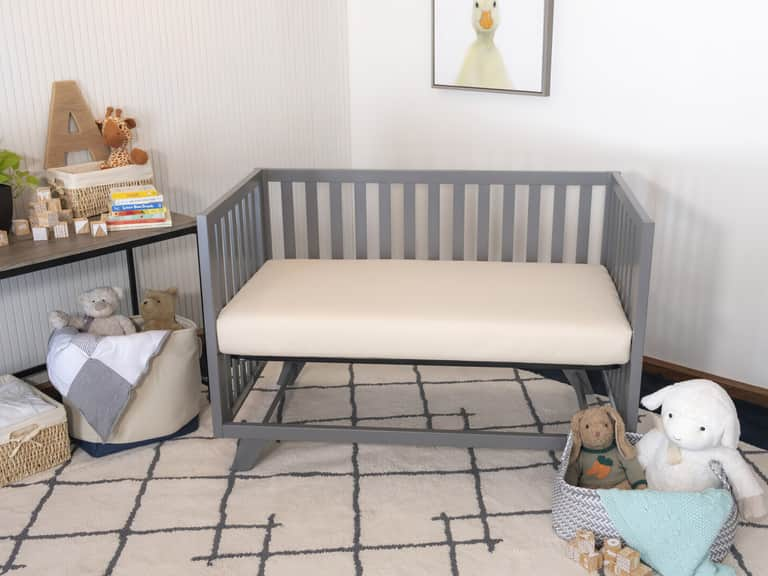
Once the mattress is in place, follow the crib maker’s instructions for checking fit. The mattress should sit securely in the frame without an unsuitable gap around its edges. Do not use rolled towels, improvised fillers, or other objects to compensate for a mattress that does not fit. If the dimensions or fit seem questionable, stop and contact the crib or mattress manufacturer rather than trying to solve the problem with extra bedding.
Thickness and shape matter, too. A mattress that appears to be the right length and width may still not be approved for a particular crib if its thickness or design conflicts with the frame’s instructions. Likewise, a fitted sheet should be designed for the mattress and remain secure when properly installed. A loose or poorly sized sheet undermines the neat, dependable setup parents are trying to create.
Fit is not glamorous. It does not have the soft-focus appeal of a quilted nursery photograph. But it is one of the most concrete things a shopper can verify: compare the numbers, check the manufacturer’s instructions, and inspect the assembled sleep surface before use.
Waterproof protection and the question of layers
Infants and toddlers produce the kinds of small accidents that make washable bedding seem less like an indulgence than a household necessity. A waterproof surface can help keep liquid from reaching the mattress interior, while a removable washable layer can make routine cleanup more manageable. The details matter: a protector may be integrated into the mattress, supplied as a separate pad, or sold as an accessory.
Before adding a waterproof crib pad, check the product’s dimensions, construction, and care instructions. It should be intended for the crib and compatible with the mattress. A pad that bunches, shifts, changes the surface, or conflicts with the mattress maker’s directions is not a useful upgrade. The simpler arrangement is usually the better one: use only the layers the product instructions allow, secure them as directed, and avoid adding cushioning just to make a surface feel more plush.
One example of a separate moisture layer is the Naturepedic Waterproof Organic Cotton Crib Mattress Pad. The product information describes a flat pad measuring 28 by 52 inches, with organic cotton flannel on top, organic cotton muslin underneath, and a thin waterproof inner layer. It is designed to be layered under a crib sheet. The listing also specifies machine washing and drying. Those details make it possible to consider how the pad might fit a bedding routine, but they do not replace checking dimensions and compatibility against the particular mattress and crib instructions.
Care instructions deserve more attention than they often get. A pad that can be washed may be convenient, but the recommended cycle, detergent, drying method, and any restrictions still apply. High heat, bleach, or fabric softener may be inappropriate for some materials. Keep the product label or instructions where they can be found after the packaging has been discarded; the laundry room is an unromantic but important part of nursery planning.
Considering a Naturepedic two-stage mattress
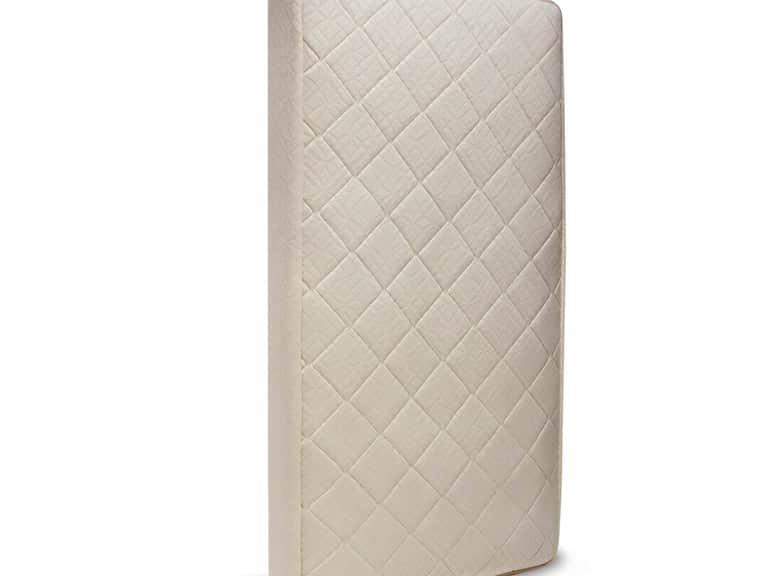
For shoppers comparing organic crib mattresses, Naturepedic offers two-stage models that illustrate how materials, support, and maintenance can be combined in different ways. The Naturepedic Breathable 2-Stage Organic Crib Mattress is described as a firm, flat mattress with a removable, breathable, washable pad on top. Its product information describes a firm infant side and a plusher toddler side, along with a waterproof mattress surface and organic cotton. The listing gives approximate dimensions of 27¼ by 51⅝ by 6 inches and describes lightweight and innerspring options.
The Naturepedic Ultra Breathable 2-Stage Organic Crib Mattress is also described as a two-part system: a supportive mattress with a breathable pad on top. Its listing highlights a waterproof outer surface and gives approximate dimensions of 27¼ by 51⅝ by 6 inches. The described construction and options differ, so it is worth comparing the current specifications rather than assuming that models with similar names are identical.
These product descriptions can help organize a comparison, but they should not be read as independent testing or medical advice. Confirm current features, available versions, dimensions, certifications, and care instructions with the manufacturer or retailer before purchase. If a product includes a separate pad, check the instructions for how it should be attached, washed, and used. If it has a toddler side, follow the maker’s criteria for turning it.
Price and weight may also matter. A lighter mattress can make sheet changes easier; an innerspring option may have a different feel and heft. Neither characteristic answers every question about suitability. The useful comparison is the one that considers the actual crib, the household’s cleaning routine, the product’s documented specifications, and the family’s material preferences.
A calm, methodical buying checklist
When nursery decisions begin to multiply, a short checklist can be more helpful than another round of abstract comparison. Before settling on a mattress, consider the following:
- Crib compatibility: Check the crib manufacturer’s mattress requirements and compare them with the mattress’s stated dimensions and thickness.
- Firm, flat surface: Confirm that the mattress is intended for the child’s stage and follow current safe-sleep guidance and product instructions.
- Materials and certifications: Read which materials are used and which, if any, are covered by named certifications. Ask for clarification when the description is vague.
- Construction: Compare the support system, weight, cover design, and any included components without treating a single feature as a guarantee of quality or safety.
- Waterproofing: Find out whether protection is built into the mattress or comes as a separate layer, and whether additional protectors are permitted.
- Care: Note whether the cover or pad is removable, what washing method is recommended, and how each piece should be dried.
- Two-stage design: If the mattress has infant and toddler sides, record the manufacturer’s instructions for when and how to turn it.
- Returns and support: Review the retailer’s return terms and keep product documentation in case a fit or care question arises.
This is not a demand for certainty on every point. It is a way of replacing vague impressions with verifiable details. A mattress that is easy to understand and maintain may be a better match for a household than one with a longer list of features but unclear instructions.
Care is part of the product
A mattress’s useful life depends partly on what happens after it arrives. Follow the manufacturer’s guidance for cleaning and ventilation. If the mattress is not designed to be immersed or machine-washed, do not treat it as if it were. A removable cover or pad should be washed according to its own label, not according to assumptions borrowed from another bedding item.
After a spill, use the cleaning method specified for the mattress and allow components to dry as directed before making the bed again. Moisture trapped in a cover, pad, or mattress can create problems over time. Waterproofing may help protect the interior, but it is not a reason to ignore dampness or to assume that every liquid has been fully contained.
Check the mattress and crib periodically for signs of wear, damage, or changes in fit. If a component is torn, a cover no longer stays secure, or the mattress appears to have changed shape, consult the manufacturer. A product’s description at the time of purchase does not override its condition years later.
The quiet virtue of a good fit
Parents are asked to make consequential decisions through the language of commerce, where every feature seems essential and every material has a story. It can be tempting to search for one decisive word—organic, breathable, waterproof—and let it carry the whole decision. But a crib mattress is better understood as a collection of practical particulars: its dimensions, structure, surface, materials, compatible bedding, and care requirements.
Organic materials may be a meaningful priority. Breathability may be part of a thoughtful design. Waterproof protection may make cleanup easier. Their value is clearest when each is considered in context and when the mattress fits the crib and is used according to the instructions. A separate cotton pad, including the Naturepedic option described above, can be a useful part of a routine only if its size and use are appropriate for the specific setup.
The aim is not to make the nursery elaborate. It is to make it legible: a mattress that fits; a firm, flat sleep surface; bedding used as directed; and a care plan that does not rely on guesswork. In the middle of the night, when the small operations of family life begin again, that kind of clarity is its own form of comfort.